

How to Choose Wrist Wraps for Lifting — Stoic Performance
By Brandon, Founder · Stoic Performance · Updated May 2026
What wrist wraps actually do
Wrist wraps immobilize the joint under load. When you press a heavy barbell — bench, overhead, anything — your wrist can extend backward under the bar if it is not adequately braced. That hyperextension is uncomfortable at lighter loads and potentially injurious at heavy ones. A wrap holds the wrist neutral through the movement.
They are not a crutch. They are a tool for heavy pressing the same way a belt is a tool for heavy squats and deadlifts. Use them for the heavy sets where the joint is under real stress. Take them off for everything else.
The failure points — and what to look for

Every wrist wrap fails at the same two places: the thumb loop and the hook-and-loop closure (Velcro).
The thumb loop is the anchor point. When you apply a wrap, the loop holds it in position while you wind it around the wrist. A thin, narrow, or poorly-attached loop will fray, snap, or pull away over time — especially across thousands of wrap applications over years of training. Look for a thick, reinforced loop.
The hook-and-loop closure has to hold under the rotational stress of heavy pressing. Cheap Velcro delaminates and weakens with washing. Eventually the wrap releases mid-set. Quality closure material costs more and holds longer. We have sold wraps for long enough to know exactly which parts fail and which don't — ours are built accordingly.
Which length to use — 18", 24", or 36"
The length determines how many passes you can make around the wrist and how rigid the brace ends up. A longer wrap wound tightly produces more wrist immobilization. But it is not purely about the weight you lift — wrist size and personal preference matter too.
Right for most lifters. As a rough reference: most people are comfortable pressing around 400 lb using an 18" wrap. If you are not sure, start here.
Middle ground. More coverage and rigidity without the full 36". Works well for larger wrists or lifters who want more support without committing to maximum length.
Maximum rigidity. Built for heavy pressing loads and lifters who need full wrist immobilization. At elite pressing weights, the extra passes matter.
A few things that matter when applying them
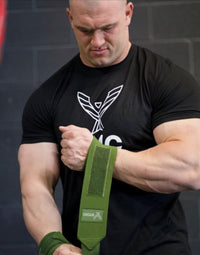
Apply them tight enough to matter. A loose wrap does almost nothing. The joint needs to be held. This is also why the thumb loop matters — you need something to tension against while you wind.
Position them across the wrist joint. The wrap should sit directly over the joint, centered on the crease. Riding it up the forearm provides less support and may cause sliding during the set.
Take them off between sets if you are not pressing. Wearing them continuously restricts blood flow without benefit outside the actual lift.
When not to use them
For accessory work, warm-ups, and anything that is not a heavy pressing movement — take them off. Let your wrists develop the supporting strength they need. Wraps reduce that demand when worn constantly. They are a tool for the heavy sets, not a permanent fixture.
If you are not sure which length to start with: 18". It handles the large majority of lifting applications and is where most serious lifters stay.
— Brandon, Stoic Performance
Training notes, new gear, and the occasional buying guide.
No filler. Unsubscribe any time.
WHAT ATHLETES ARE SAYING...